


Complex Schemes Made Simple: Handling "Buy 10 Get 1" Logic Without Manual Calculation
Buy-get offers calculated correctly every time, without spreadsheets or rework.
Executive Summary: The "Trade Spend" Black Hole
In the Indian distribution and manufacturing landscape (FMCG, Pharma, Consumer Durables), the "Price List" is merely a suggestion. The real transaction happens through Schemes.
"Buy 10 Get 1 Free." "Purchase ₹50,000 value, get 5% Cash Discount." "Buy 3 Cases of Shampoo, get 1 Case of Conditioner at 50% off."
For a mid-market enterprise (₹50 Cr – ₹500 Cr), schemes are the primary lever for moving inventory and incentivizing channel partners. However, our analysis of over 200 distribution businesses reveals a startling inefficiency: 90% of scheme calculations happen manually.
They happen on the calculators of sales reps standing in humid retail shops. They happen on scribbled notes sent via WhatsApp. They happen in the minds of data entry operators trying to decipher handwritten orders.
This manual dependency creates a "Trade Spend Black Hole." It leads to revenue leakage (reps applying expired schemes), GST non-compliance (incorrect tax on free goods), and massive friction in the Order-to-Cash cycle.
This blog post explores how automating scheme logic using sales scheme management software transforms your trade spend from a chaotic expense into a precision tool. We analyze the shift from "Manual Calculation" to "Algorithmic Pricing" and how integrating this directly with Tally Prime via Effortless ensures that your strategy in the boardroom matches the reality in the market.
1. The "Scheme Economy": Why Indian Trade is Unique
To understand the problem, we must respect the complexity of the Indian market. Unlike Western markets where "Net Pricing" rules, Indian trade runs on "layered incentives."
The Anatomy of a Deal: A distributor selling to a retailer isn't just selling a product. They are navigating a matrix of:
Primary Scheme: Quantity slabs (Buy 12, Get 1).
Secondary Scheme: Target-based incentives (Achieve ₹1L this month, get 2% Credit Note).
Spot Scheme: Slow-moving stock liquidation (Today only: Extra 3% off).
Payment Terms: Cash Discount (CD) for immediate payment.
The Complexity Multiplier: Now, multiply this by 500 SKUs, 2,000 Retailers, and 50 Sales Reps. Every day, your sales team is making thousands of mathematical decisions. If they rely on memory or a PDF price list stored on their phone, error is not a possibility; it is a mathematical certainty.
The "Manual" Cost: Manual billing and delayed collections drain MSMEs with hidden costs — from GST errors to cash flow crunches. When a rep miscalculates a scheme, two things happen:
Under-Charging: You lose margin instantly.
Over-Charging: You lose trust. The retailer disputes the bill. You issue a Credit Note. The GST filing gets messy. The cash flow stalls.
2. The "Calculator" Trap: Where Margins Go to Die
Let's walk through a typical "Manual" scenario without automation.
The Scenario: Your Sales Rep, Ravi, visits "Shankar Distributors." You have launched a new scheme: "Buy 100 Cases of Biscuits, Get 10 Case Free + 2% Off if billed today."
The Process Failure:
The Pitch: Ravi pitches the scheme. Shankar-ji agrees.
The Calculation: Rahul pulls out his calculator.
10 Cases = ₹100,000.
Free Item = ₹10,000 (Taxable? Not taxable? Rahul guesses).
2% Discount = ₹2000.
GST Calculation: Rahul calculates GST on the Net Amount manually.
The Error: Ravi forgets that the "2% Off" was only for Cash payment. Shankar-ji is paying on credit. But Ravi applies the discount anyway to close the sale.
The Sync Lag: Ravi writes this on a pad and WhatsApps it to the office. The Data Entry operator types it into Tally.
The Audit Find: Three months later, your Internal Auditor asks why you gave a Cash Discount on a Credit Sale. The money is already gone.
The Solution: Algorithmic Guardrails You need discount automation Tally solutions that remove the calculator from the equation. The logic must live in the App, not in Ravi’s head.
3. The Effortless Solution: "Zero-Touch" Scheme Application
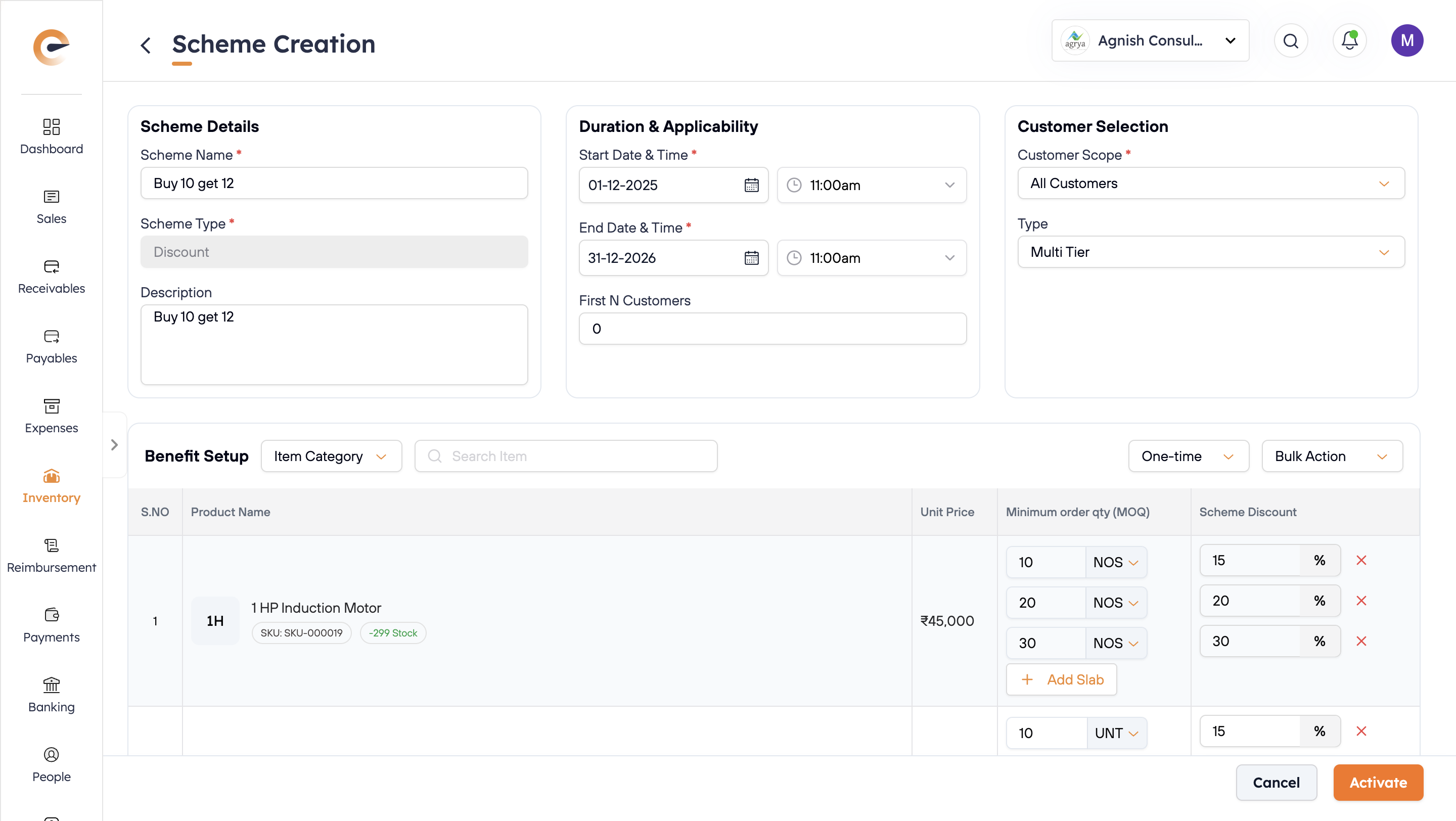
Effortless approaches schemes not as "Discounts" but as "Rules." We have built a proprietary "Scheme Engine" that sits between your Field Force and your Tally Data.
How It Works:
Define the Rule (Head Office): The Sales Head defines the scheme in the Effortless Admin Portal.
Rule: If SKU Category = "Biscuits" AND Qty >= 10, Then Add Item "Biscuit (Free)" AND Discount = 0%.
Constraint: Valid from Jan 1st to Jan 31st.
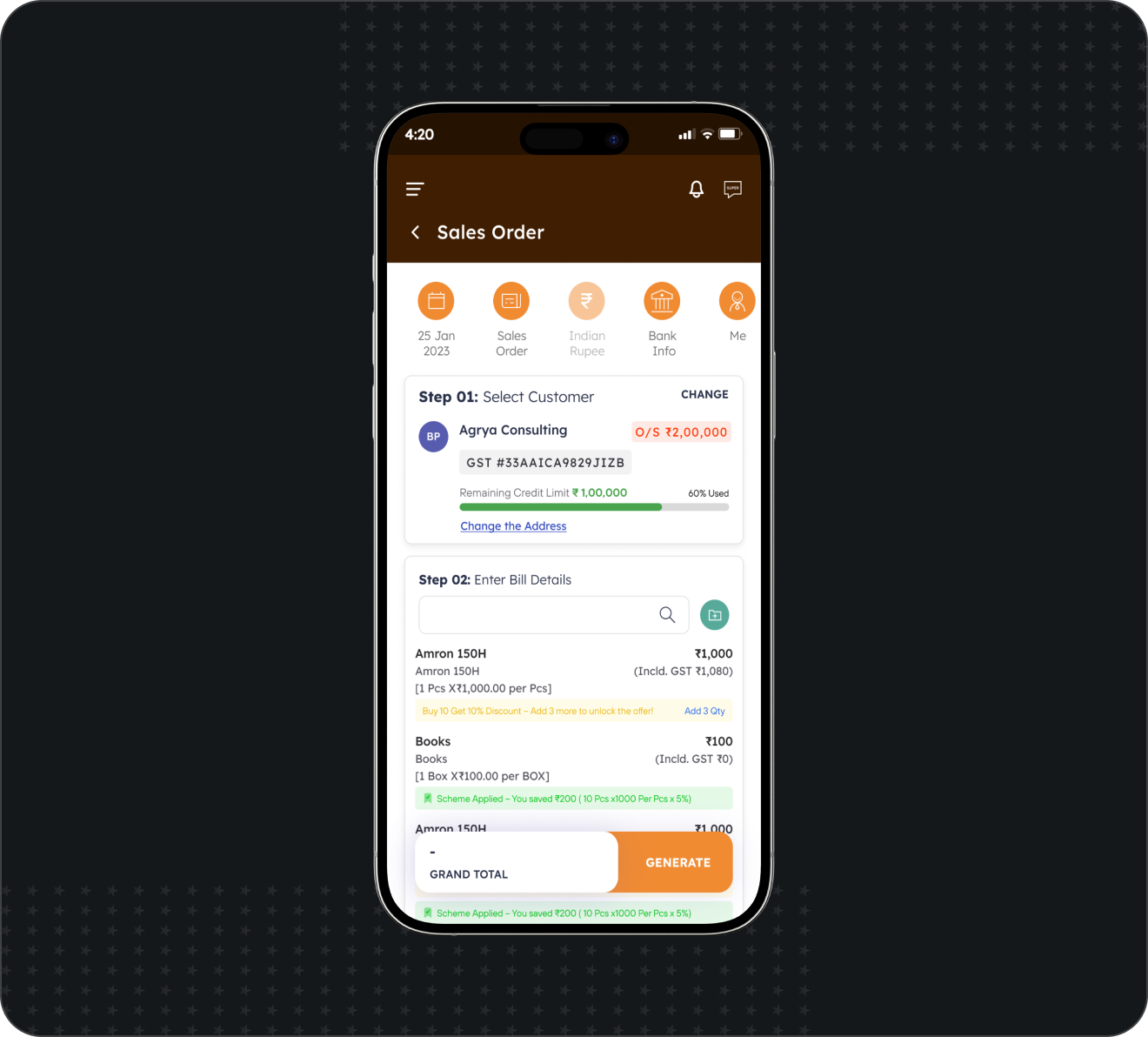
The Field Execution (Mobile App): Ravi visits the shop. He opens the mobile order-taking app. He selects "10 Cases of Biscuits."
The Automation:
The App instantly auto-adds the "1 Free Case" to the cart.
It highlights the "Scheme Applied" banner.
If Ravi tries to add a 2% discount manually, the App checks the "Payment Mode." If "Credit" is selected, the discount field is locked.
The Invoice: The order syncs to Tally. The invoice is generated with the exact scheme details. How to avoid GST penalties through automated billing software? By ensuring the free item is billed correctly (e.g., at ₹0.01 or with correct tax treatment) as per your pre-set GST logic.
Result: Zero calculation error. 100% Policy Adherence.
4. Deep Dive: Handling Complex Logic Scenarios
Let’s look at three specific complex scenarios that sales scheme management software like Effortless handles seamlessly.
Scenario A: The "Slab" Logic (The Volume Driver)
Logic:Buy 0-10 (0% off); Buy 11-50 (5% off); Buy 51+ (8% off).
Manual Risk: Rep splits a big order into two small orders to help a friend, losing the volume benefit. Or Rep gives 8% on a 40-unit order.
Effortless Fix:The App reads the total quantity. As the retailer increases the order size from 10 to 11, the price dynamically updates on the screen. The retailer sees the price drop, incentivizing them to buy more. This is "Psychological Selling" powered by code.
Scenario B: The "Product Bundling" (The Mix Driver)
Logic:Buy 5 Cases of "Fast Mover" (Soap) to get 1 Case of "Slow Mover" (Sanitizer) at 50% off.
Manual Risk:Rep sells the Soap but "forgets" to push the Sanitizer. Or sells the Sanitizer at 50% off without the Soap.
Effortless Fix:The App enforces the bundle. You cannot add the discounted Sanitizer unless the Soap quantity is in the cart. This forces secondary sales tracking of slow-moving inventory.
Scenario C: The "Billed vs. Free" GST Challenge
Logic:Free items are tricky under GST. You technically need to reverse ITC or bill them at a nominal value.
Manual Risk:Rep billing "Zero Value" creates a GST mismatch notice.
Effortless Fix:You configure the logic once (e.g., "Bill Free Item at ₹0.10 + GST"). The Tally-integrated GST billing software India engine ensures every free item follows this tax structure automatically.
5. Secondary Sales Tracking: The "Real" Demand
Schemes are often used to push "Primary Sales" (Distributor to Retailer). But are they driving "Secondary Sales" (Retailer to Consumer)?
The Visibility Gap: In a manual system, you know you gave a discount. You don't know if it worked. Did the retailer pass it on? Did the stock move?
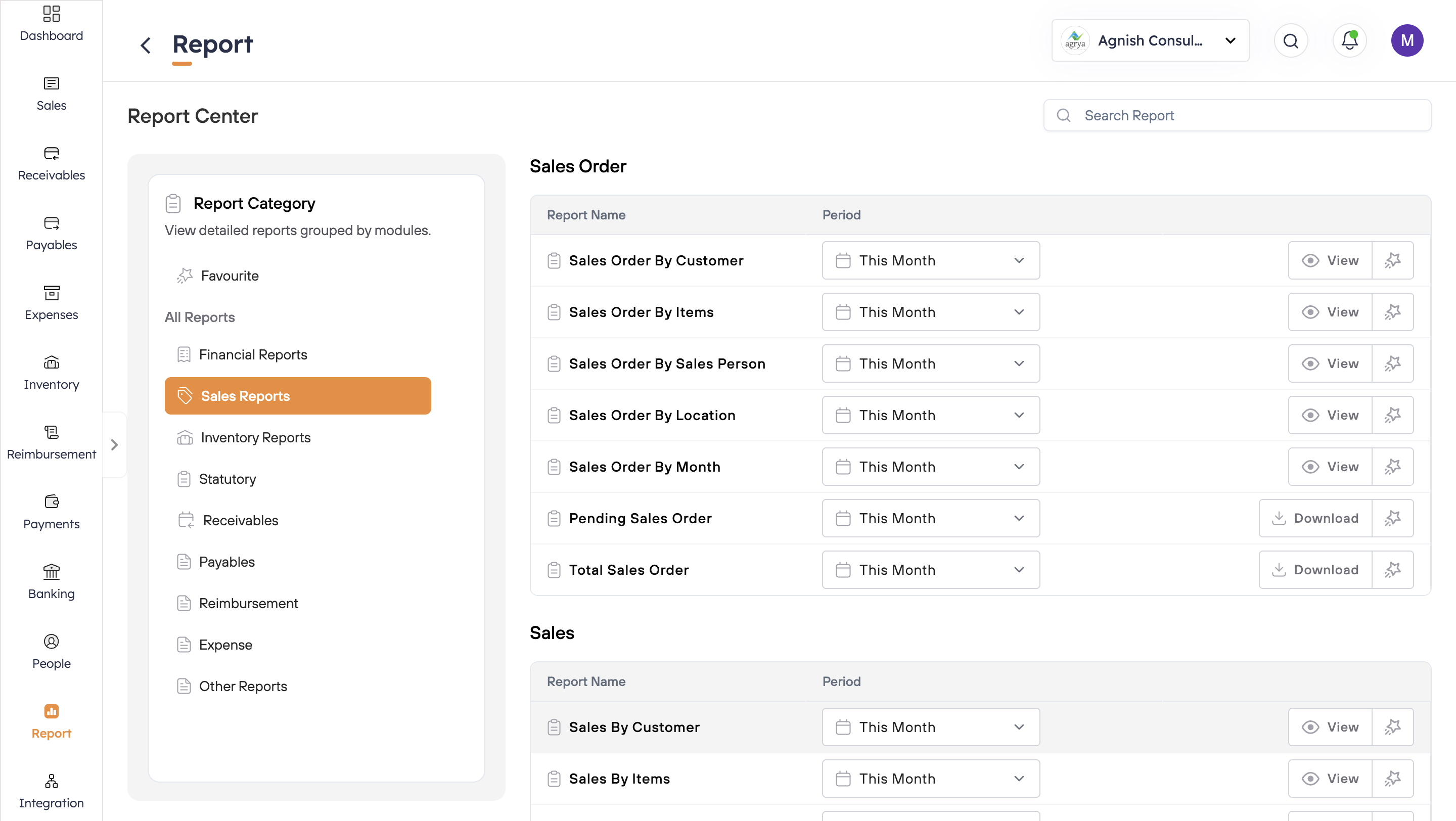
The Data Advantage: With Effortless acting as your distributor sales mobile app, you get granular data:
Which scheme drove the highest volume per outlet?
Which region utilized the "Bulk Buy" scheme the most?
This allows for "Precision Discounting." Instead of a blanket 5% off, you realize: "In North Zone, the Buy-10-Get-1 works best. In the South Zone, the Cash Discount works best." You stop burning money on ineffective schemes.
6. The Cash Flow Connection: Schemes & Collections
Schemes and Collections are siblings. You give a discount in exchange for faster payment.
The Disconnect: Often, the Sales Rep promises a "Cash Discount" (CD), but the customer pays in 15 days. The Rep doesn't go back to collect the difference. You lose the CD and the interest cost.
The Solution: Automated Payment Terms Effortless links the Scheme to the Payment Workflow.
Invoice Generation: The invoice reflects the CD conditional on payment date.
The Reminder: How to send automatic payment reminders to customers on WhatsApp? On Day 1, Effortless sends a WhatsApp: "Pay Invoice #123 by tomorrow to retain your ₹500 Cash Discount."
The Enforcement: If payment is late, the system can automatically generate a Debit Note for the discount reversal (if configured).
This tightness is essential for Cash flow management software for MSMEs India. It ensures you aren't funding your customer's working capital for free.
7. Tally Integration: The "One Truth" Architecture
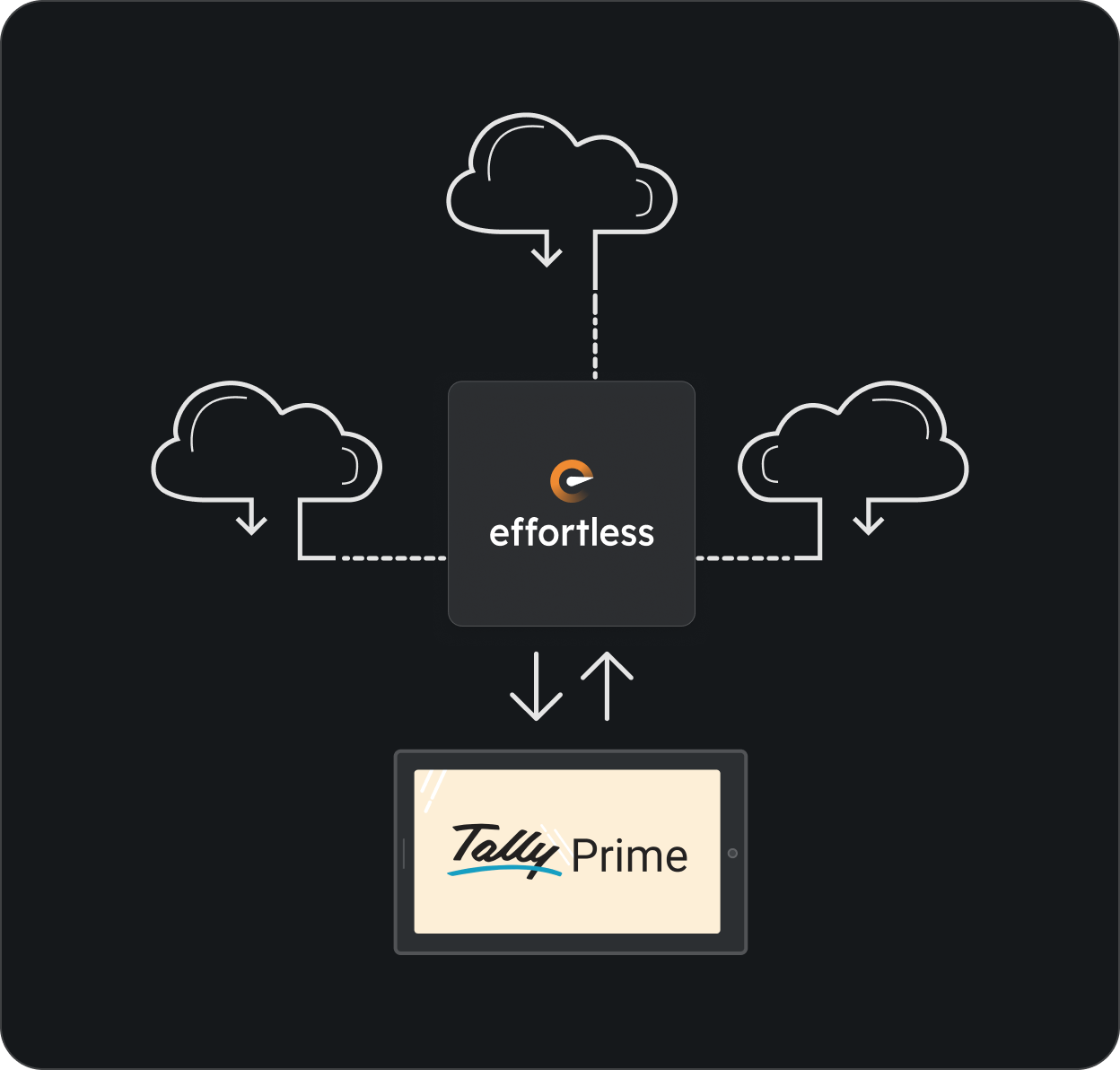
The magic of Effortless is that it doesn't create a parallel universe. It lives on top of Tally.
The Sync:
Masters: Your Stock Items, Price Lists, and Ledgers sync from Tally to Effortless.
Transactions: The Sales Order (with scheme applied) syncs from Effortless to Tally.
Bank: How to automate bank reconciliation with Tally? When the discounted payment comes in, Effortless auto-reconciles it, ensuring the "Discount Allowed" ledger matches the scheme given.
This App to validate GSTIN and automate e-invoicing capability means your accountant doesn't need to re-verify the scheme calculation. The "System" is the auditor.
8. Strategic Verdict: Stop "Spending," Start "Investing"
Manual schemes are a "Spend." You throw money at the market and hope it sticks. Automated schemes are an "Investment." You deploy capital with precise rules, track the return, and eliminate leakage.
For the Founder scaling from ₹50 Cr to ₹500 Cr, the math is simple:
Revenue: ₹100 Cr.
Trade Spend: 10% (₹10 Cr).
Leakage due to manual error: 5% of Spend (₹50 Lakhs).
By implementing Effortless, you add ₹50 Lakhs to your bottom line simply by enforcing the rules you already created.
Don't let your calculator decide your profit. Let the Algorithm do it.
Key Takeaways & FAQ
Q1: Can Effortless handle complex "Slab-based" pricing?
A: Yes. Our scheme engine supports Quantity Slabs (Buy 10-20, Buy 21-50), Value Slabs (Buy ₹10k, Buy ₹50k), and Mix-and-Match bundles. The price updates dynamically in the sales order Android app as the rep adds items.
Q2: Does this work for "Free Items" with GST?
A: Absolutely. We understand Indian GST nuances. You can configure the system to bill free items at zero, at nominal value (₹0.01), or with 100% discount, ensuring your Tally-integrated GST billing software India generates compliant invoices every time.
Q3: How to automate invoice generation and payment reminders in India for scheme-based bills? A: Once the scheme-applied order syncs to Tally, Effortless triggers the invoice generation. It then reads the "Due Date" and automatically sends WhatsApp reminders with payment links, ensuring you collect the cash before the scheme benefit is eroded by interest costs.
Q4: Can I prevent sales reps from giving unauthorized discounts?
A: Yes. Effortless allows you to set "Floor Prices" or lock discount fields based on user roles. A sales rep might be capped at 5%, while a Manager (approving via app) can authorize up to 10%. This is crucial workflow automation for margin protection.
Suggested Reading from the Effortless Edge Blog
The "Blind Spot" Audit: 5 operational metrics you cannot see in your Tally Profit & Loss – Understand why manual scheme calculations are invisible in Tally.
Why "Generic" Cloud ERPs Fail in Indian Distribution Businesses – See why global tools fail at Indian "Buy 10 Get 1" complexity.
Instant Gratification: Why syncing orders to Tally in real-time makes customers happier – Learn how fast invoicing locks in the sale.
IPO Ready: How to prepare your financial data for due diligence – Clean scheme data is key to revenue assurance.
Is your "Buy 10 Get 1" costing you "Buy 10 Get 2"? [Book a Demo] and audit your trade spend leakage today.
Growth Doesn't Wait. Why Should You?
Let Effortless help you scale—without the scramble.
Talk to Us
Have questions about how Effortless can transform your business? Our team of experts is ready to help.
- Schedule a personalized demo
- Get your specific questions answered
- Discuss your unique business challenges
We'll reach out within 4 business hours
Request Demo
See Effortless in action with a personalized demo tailored to your business.
- No generic presentations
- Focus on your specific challenges
- Get a clear picture of your potential ROI
Choose a time that works for you
Your Growth Engine Starts Here
More growth, less overhead. Discover how India's fastest growing businesses do it.
- Automate invoicing, collections & approvals
- Track sales team performance
- Get cashflow clarity in real-time
Clarity in 30 minutes. No pressure, just proof.