


The "Month-End" Autopsy: Why Backdated Entries Are Destroying Your Audit Trail
Backdated entries distort reports and trigger audit risk.
Executive Summary: The Illusion of Closed Books
For many mid-market Indian enterprises (₹50 Cr – ₹2500 Cr), the concept of "closing the books" is more of a suggestion than a reality. It is a well-known secret that in many finance departments, the books for March aren't actually closed until mid-April—sometimes even May.
Why? Because of the chronic habit of backdated entries.
Accountants routinely dive back into closed periods in Tally Prime to adjust margins, fix forgotten expenses, or tweak inventory valuations. While this flexibility made Tally famous, it is precisely this lack of hard controls that becomes a massive liability as a company scales.
When an auditor (internal or external) finds a trail of backdated alterations, trust evaporates. It signals a lack of governance. It raises questions about financial integrity, creates GST compliance nightmares, and makes a mockery of your month-end P&L reports.
This blog post attacks the cultural and operational habit of editing closed months. We explore why "soft" policies fail and how implementing an operational layer like Effortless—specifically its Cut-Off Date Controls—acts as the ultimate "bad cop," forcing accounting hygiene and securing your audit trail.
1. The Anatomy of a Backdated Entry
Let's dissect why backdated entries happen. It is rarely malicious; it is usually a symptom of poor operational flow.
The "Forgotten Bill" Scenario: It is April 15th. The procurement manager finds a vendor invoice from March 28th sitting in his drawer. He gives it to the accountant.
The Accountant's Dilemma: If he books it in April, the March P&L is wrong, and the Q4 numbers drop. If he books it in March (backdating), he messes up the GSTR-2B reconciliation that was already filed.
The "Tally" Action: He chooses the path of least resistance. He alters a closed period in Tally.
The "Margin Management" Scenario: The Founder looks at the March P&L on April 5th. "Profits are too high; we need to increase our provision for bad debts to manage tax," he says.
The Action: The accountant passes a backdated Journal Voucher on March 31st.
While these actions seem like necessary business maneuvers, they create a fractured reality. The financial report you reviewed on April 2nd is now different from the one you see on April 10th. This is not accounting; it is an autopsy that keeps changing the cause of death.
2. The Hidden Cost of the "Open Ledger"
The freedom to edit past data is a direct threat to your scaling ambitions. Manual billing and delayed collections drain MSMEs with hidden costs — from GST errors to cash flow crunches. But an "open ledger" drains credibility.
A. The GST Nightmare (Input Tax Credit Loss) When you backdate a purchase invoice into a period where the GST returns (GSTR-3B) have already been filed, you create a permanent mismatch.
The Risk: You might forget to claim the Input Tax Credit (ITC) in the subsequent month, losing 18% of the value.
The Scrutiny: When the GST department notices that your Tally Purchase Register does not match the filed GSTR-3B for that specific month, it triggers notices and penalties.
B. The Useless MIS Report If a CEO looks at a "Flash P&L" on the 3rd of the month, they make strategic decisions based on those numbers (e.g., approving a marketing budget). If the finance team secretly alters the previous month's data on the 12th, the CEO is flying blind. A dashboard is only as good as the finality of its data.
C. The Audit Trail Mandate (MCA Compliance) The Ministry of Corporate Affairs (MCA) mandate regarding "Edit Logs" in accounting software changed the game.
The Reality: Tally Prime captures these edits. Your auditor will see a massive report showing hundreds of altered or backdated vouchers.
The Consequence: The auditor will spend weeks questioning why these edits were made, significantly increasing your audit fees and delaying your final sign-off.
3. Why "Policies" Fail and "Systems" Succeed
Most CFOs know backdating is bad. They issue memos: "No entries in the previous month after the 5th."
But a memo is a "Soft Control." When the Founder demands a change, or a critical vendor threatens to stop supply because their bill was missed, the accountant will break the rule. The accountant becomes the bottleneck and the bad guy.
The Strategic Shift: You must shift from "Permission" to "Physics." You need a "Hard Stop." This is where change management finance teams struggle. You cannot force discipline purely through willpower; you must build it into the software.
4. The Effortless "Audit Shield": Cut-Off Date Controls
This is why mid-market companies implement Effortless on top of Tally. Effortless acts as the operational governance layer, protecting the core ledger.
How the "Cut-Off Date Control" Works:
Step 1: The CFO Sets the Boundary In the Effortless admin panel, the CFO sets a definitive "Cut-Off Date" (e.g., "Books close on the 5th of the following month").
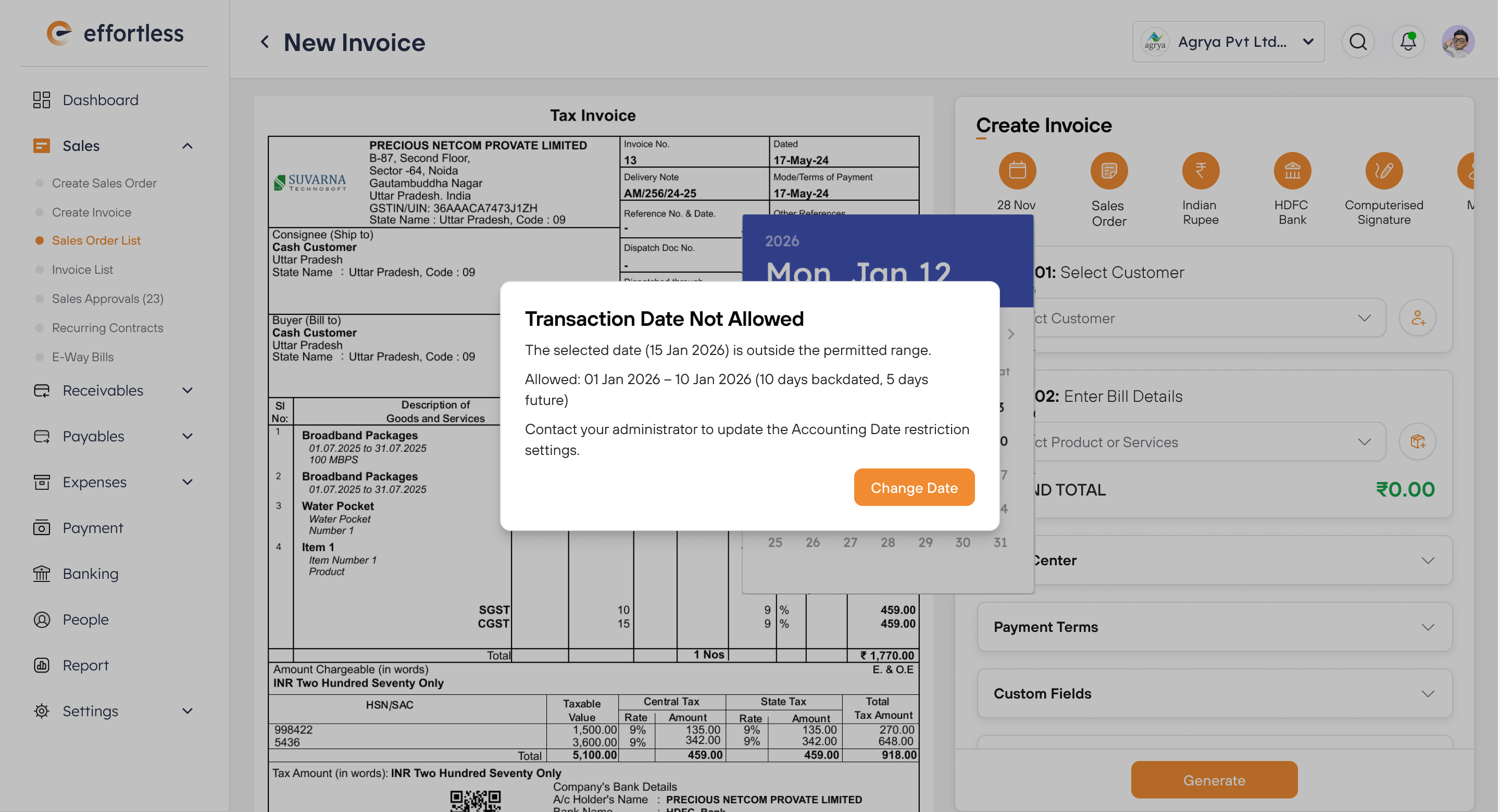
Step 2: The Hard Stop On April 6th, a branch manager tries to upload a missing vendor bill dated March 29th using the mobile bill booking app.
The Action: He enters the date: 29-03-2026.
The Effortless Response: A hard error pop-up appears: "Transaction Date Not Allowed. The period is closed."
Step 3: The Forced Reality The manager cannot bypass this. He must enter the bill with an April date (recognizing the liability now) or escalate it to the CFO for a formal, audited override.
The Psychological Impact: The software becomes the "bad cop." The CFO doesn't have to argue. The system simply does not allow it. This forces the operations team to submit their data on time.
5. Closing the Loops Before Month-End
A "Hard Stop" is only effective if you give your team the tools to actually finish their work on time. You cannot lock the door if the data is still traveling via courier.
To make "Period Closure" a reality, Effortless accelerates the data flow across three critical areas:
A. Field Sales Velocity If sales reps take orders on paper, the data entry lags.
The Fix: Reps use the mobile order-taking app. The sales order Android app syncs data to Tally instantly. By 5 PM on the 31st, 100% of your sales revenue is accurately recorded. No backdated sales entries needed.
B. Instant Expense Capture If employees wait until the end of the month to submit travel chits, you will always have a backlog.
The Fix: Employees use the Effortless employee expense claim app. They snap a photo of the receipt the moment they pay. The GST invoice scanner extracts the data instantly. The expense is recorded in real-time, eliminating the "forgotten bill" excuse.
C. Automated Banking If your accountant is manually matching NEFTs, closure takes a week.
The Fix: How to automate bank reconciliation with Tally? Effortless fetches the bank statement daily and auto-matches receipts. The cash position is locked and reconciled daily, not monthly.
6. The Single Draft Lock: Stopping the "Edit" Chaos
Backdating isn't the only threat to the audit trail; simultaneous editing is another.
The Problem: Two accountants are reviewing the same complex Purchase Order in Tally. Accountant A changes the tax ledger. Accountant B changes the quantity. They save over each other. The audit trail is a mess.
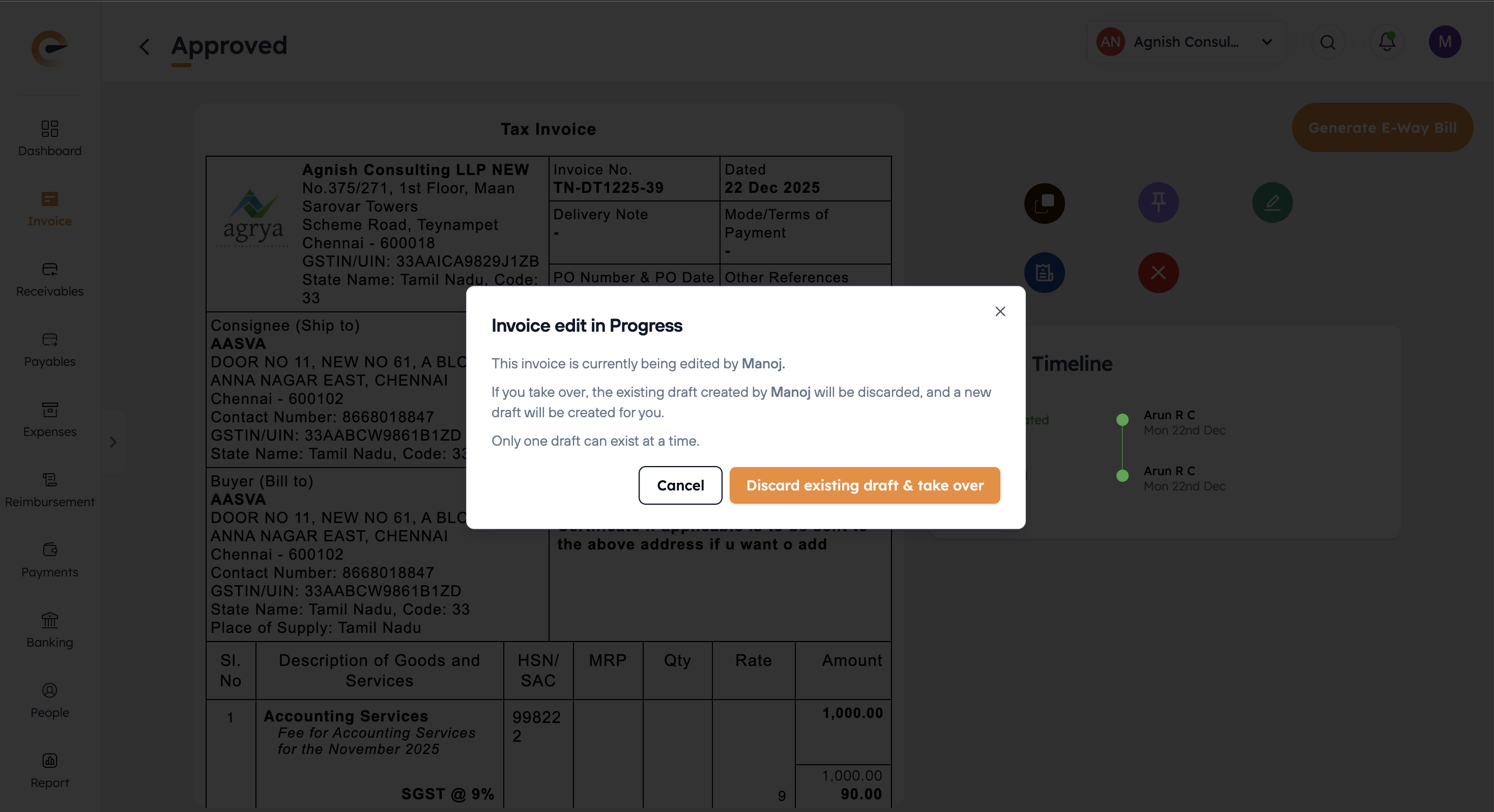
The Effortless Fix: "Version Control" Effortless implements Single Draft Control.
The Scenario: If User A opens an invoice to edit it in the Effortless portal.
The Lock: If User B tries to open the same invoice, they get a pop-up: "This invoice is currently being edited by [User A]."
The Result: It prevents conflicting versions and ensures a clean, linear audit trail before the final data ever reaches Tally.
7. Conclusion: Clean Books = Scalable Business
You cannot build a ₹500 Cr enterprise on a foundation of shifting numbers.
When you allow backdated entries, you are managing your business based on fiction. You are telling your investors, your auditors, and yourself that the rules don't matter.
By implementing the Effortless Cut-Off Date Controls, you enforce absolute accounting hygiene. You transition your finance department from a "data correction facility" into a true strategic command center.
Close your books on the 30th. And use Effortless to keep them closed.
Key Takeaways & FAQ
Q1: Will locking the dates in Effortless affect my Tally data?
A: Yes, in the best way possible. Because Effortless acts as the "front door" for your operational data (Sales, Expenses), if an entry is blocked in Effortless, it never reaches Tally. Your Tally remains pristine and audit-ready.
Q2: What if we must make a backdated entry for a genuine audit adjustment?
A: The "Cut-Off Date" is controlled by the Admin (CFO/Founder). If a legitimate adjustment is needed (e.g., year-end depreciation), the Admin can temporarily adjust the date or use specific "Admin Override" privileges, ensuring the action is logged securely.
Q3: How does this help with GST returns?
A: By preventing backdated purchase or sales invoices, you ensure that the data filed in your GSTR-1 and GSTR-3B exactly matches your Tally ledgers for that specific period. It is the definitive answer to How to avoid GST penalties through automated billing software?
Q4: Can we use this to control our field sales team?
A: Absolutely. Software user adoption strategies work best when the rules are clear. If sales reps know the system will physically block an order for the current month after 5 PM on the 31st, they will stop hoarding orders and punch them in real-time via the field sales software.
Q5: We have multiple branches. Can we set different cut-off dates?
A: Effortless is designed for multi-branch GSTN billing solutions. You can configure specific operational controls to ensure that all branches adhere to the central HO closure timeline, eliminating the stragglers.
Suggested Reading from the Effortless Edge Blog:
The ₹100 Cr Ceiling: Why Companies Stop Growing on Basic Tally (And How to Fix It) – Understand the limits of manual operations.
The "Maker-Checker" Shield: Protecting Your Tally Data from Unauthorized Edits – How to implement true financial governance.
The "Blind Spot" Audit: 5 Operational Metrics You Cannot See in Your Tally Profit & Loss – Why real-time data beats post-mortem accounting.
IPO Ready: How to Prepare Your Financial Data for Due Diligence Using Tally Prime + Effortless – Why clean audit trails equal higher valuations.
Stop fighting with backdated entries. [Watch the 30-Second Audit Demo] and see how Effortless secures your month-end close.
Growth Doesn't Wait. Why Should You?
Let Effortless help you scale—without the scramble.
Talk to Us
Have questions about how Effortless can transform your business? Our team of experts is ready to help.
- Schedule a personalized demo
- Get your specific questions answered
- Discuss your unique business challenges
We'll reach out within 4 business hours
Request Demo
See Effortless in action with a personalized demo tailored to your business.
- No generic presentations
- Focus on your specific challenges
- Get a clear picture of your potential ROI
Choose a time that works for you
Your Growth Engine Starts Here
More growth, less overhead. Discover how India's fastest growing businesses do it.
- Automate invoicing, collections & approvals
- Track sales team performance
- Get cashflow clarity in real-time
Clarity in 30 minutes. No pressure, just proof.