


Reading vs. Understanding: The Real Difference Between OCR and IDP (And Why It Matters for Your Margins)
Understanding documents, not just reading them. Reduce leakage and delays.
Executive Summary: The "Digitization" Illusion
For years, the software industry sold a lie to the finance departments of Indian mid-market enterprises (₹50 Cr – ₹500 Cr). The lie was that "Digitization" equals "Automation."
We were told that if we scanned a physical vendor bill and ran it through OCR (Optical Character Recognition) software, we had solved the manual data entry problem. We hadn't. We simply moved the problem from a physical desk to a computer screen.
In our years of consulting, we've seen finance teams buy expensive OCR tools, only to realize that their accountants are still spending hours manually verifying the output, correcting errors, and routing the digitized text to the right ledgers.
The hard truth is: OCR only reads. It does not understand.
To truly break the scale ceiling—and stop manual billing and delayed collections from draining your MSME with hidden costs—you need to move beyond simple character recognition. You need Intelligent Document Processing (IDP).
This blog post dissects the fundamental differences between OCR and IDP. It explains why relying solely on OCR is a strategic risk for complex finance operations and details how the Effortless platform utilizes AI-driven IDP to transform your "Purchase to Pay" and "Expense Management" cycles from a human bottleneck into a high-speed, compliant engine.
1. What is OCR? (The Fast Typist is not AI)
Optical Character Recognition (OCR) is a foundational technology that has been around for decades.
The Function: OCR analyzes the light and dark areas of a scanned image, a PDF, or a photograph to identify shapes. It then matches those shapes to letters, numbers, and symbols it recognizes.
The Output: It converts the image of text into a machine-readable, editable text file (.txt, .doc).
The "Fast Typist" Analogy:
Think of OCR as a very fast, but completely unthinking, typist.
If you hand the typist a vendor invoice that says "Total Amount: ₹15,400", the typist will quickly type those exact characters onto a screen.
The Fatal Flaw for Finance:
The typist (OCR) does not know what an "Invoice" is. It does not know that "₹15,400" is money that needs to be paid. It cannot differentiate between the vendor's phone number and the invoice number. It just sees a string of numbers. That’s why OCR is not intelligent.
Furthermore, OCR is incredibly rigid. It works best with strictly templated documents and clear, printed fonts. If a vendor sends a bill where the "Date" field is moved two inches to the right, or if the text is slightly skewed, the OCR template breaks, and the extraction fails.
For businesses dealing with hundreds of different vendors, each with their own unique invoice layout, template-based OCR is a maintenance nightmare.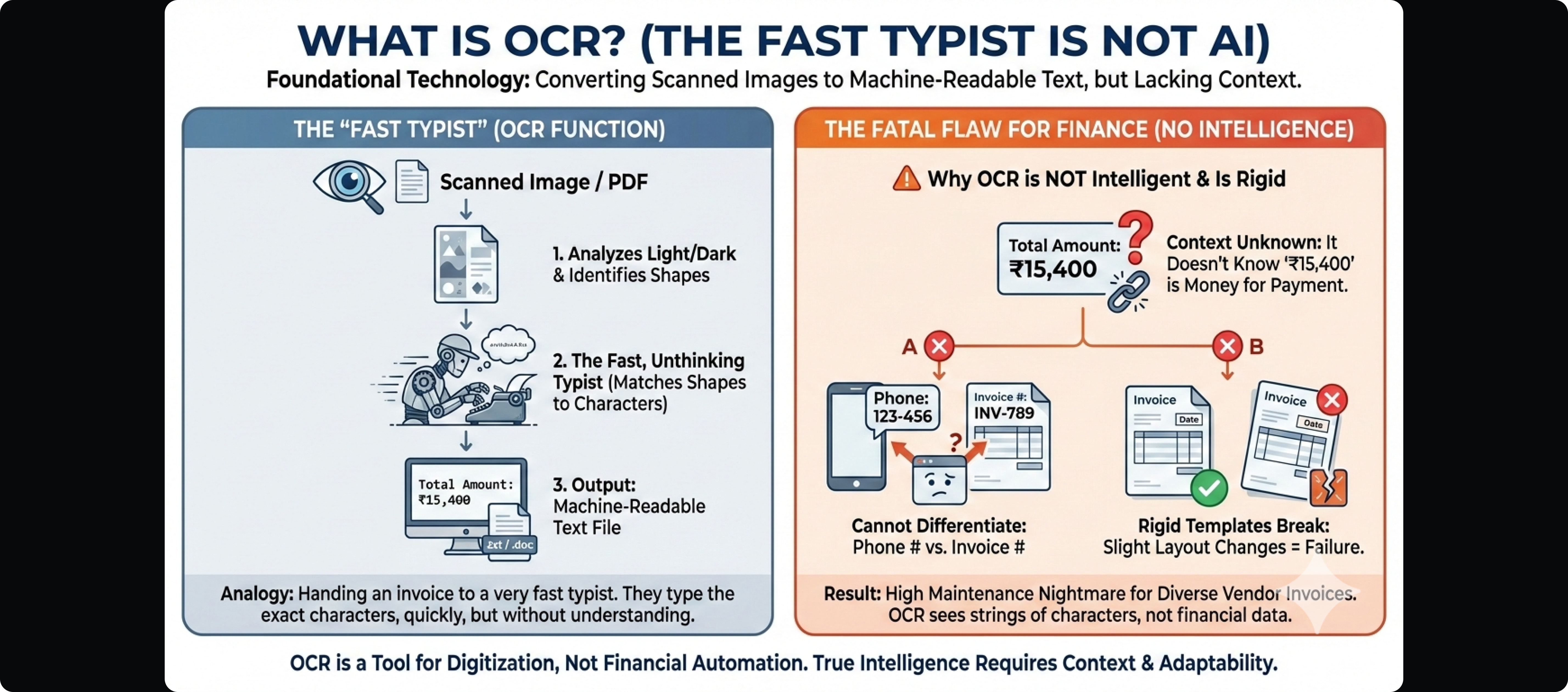
2. What is IDP? (The Digital Intelligent Accountant Co-Pilot)
Intelligent Document Processing (IDP) is the evolution of data extraction. It doesn't replace OCR; it builds upon it. OCR is just 5% of the work of IDP.
The Function: IDP uses OCR to first grab the raw text. But then, it applies a layer of Artificial Intelligence (AI)—specifically Machine Learning (ML) and Natural Language Processing (NLP)—to analyze that text.
The Output: It doesn't just output text; it outputs Structured Data with Context.
The "Digital Accountant" Analogy:
If you hand that same invoice to an IDP system, it reads "Total Amount: ₹15,400". But because of its AI training, it understands the context.
It says: "This document is an Invoice. The Vendor is ABC Corp. The Due Date is next Friday. The value ₹15,400 represents the total liability, and ₹2,349 of that is GST."
Why IDP Wins:
Template-Free: IDP does not need you to draw boxes or set up rigid templates for every new vendor. It learns to recognize the concept of an invoice, regardless of the layout.
Continuous Learning: When an IDP system makes a mistake and a human corrects it, the ML algorithm learns from that correction. Over time, accuracy approaches 99%.
Contextual Validation: IDP can apply logic. If it reads a date as "31/02/2026", it knows February doesn't have 31 days and flags it as an error.
3. The 3 Pillars of Effortless IDP for Finance
At Effortless, we recognized early on that Indian MSMEs don't just need a tool to read text; they need a system to enforce financial governance. We built our IDP engine not just as an expense management India solution, but as a "Profit Guardian."
Here is how Effortless uses IDP to solve complex finance challenges.
Pillar 1: The "Messy Reality" of Indian Bills
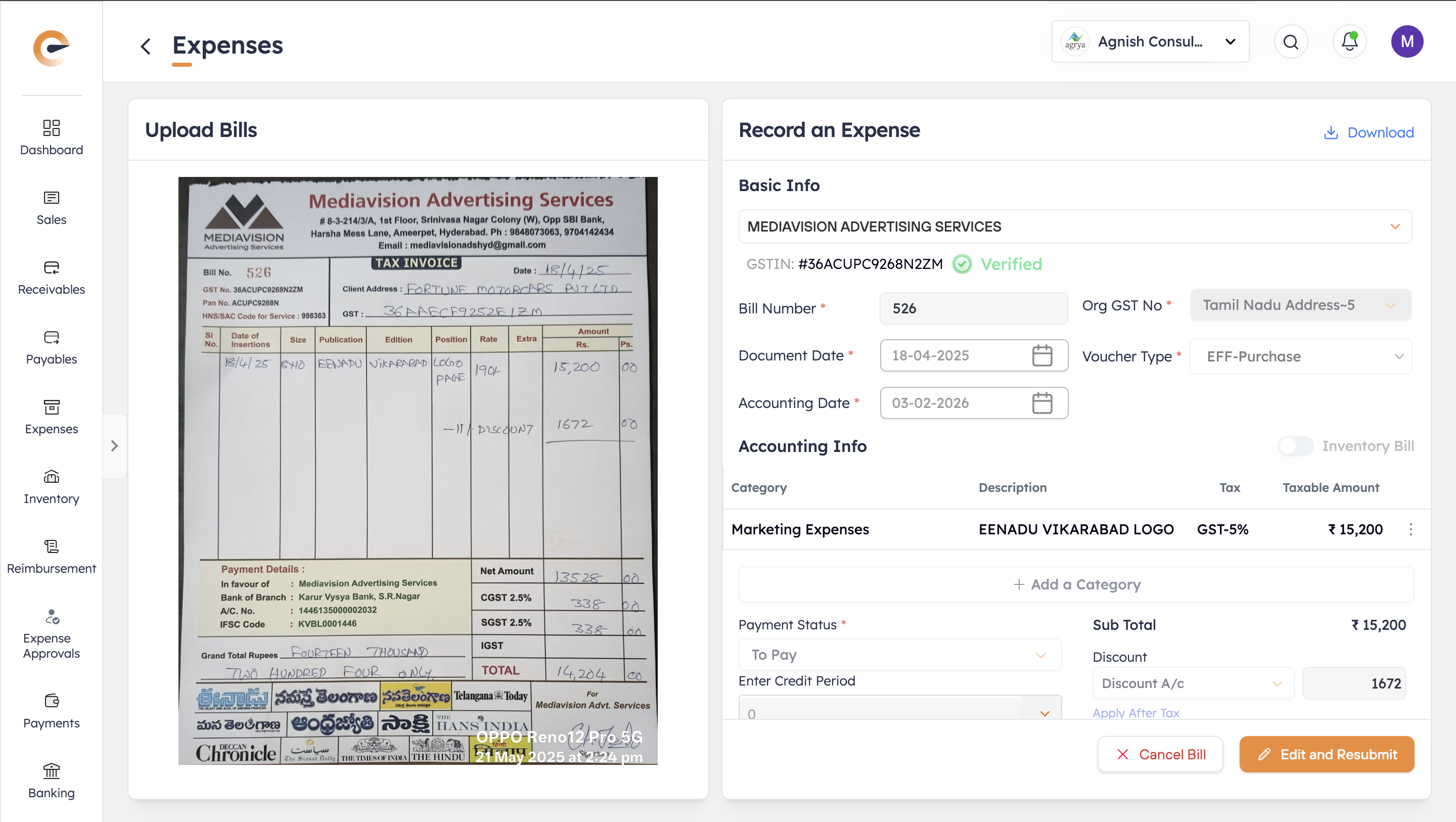
Indian business generates messy paperwork. You get faded thermal receipts for fuel, handwritten petty cash chits, and multi-page transport bills.
The OCR Failure: Traditional OCR fails completely on faded receipts and struggles massively with handwriting.
The Effortless IDP Solution: Our mobile & desktop bill booking app uses IDP equipped with advanced computer vision and deep learning models. It automatically enhances the image quality (reducing noise and glare) before extraction. It is trained to interpret unstructured data and even complex handwriting, meaning your field team can snap a photo of a handwritten toll receipt and the system will accurately extract the value.
Pillar 2: The GST & TDS Compliance Shield
This is where IDP moves from being a convenience to a critical risk management tool.
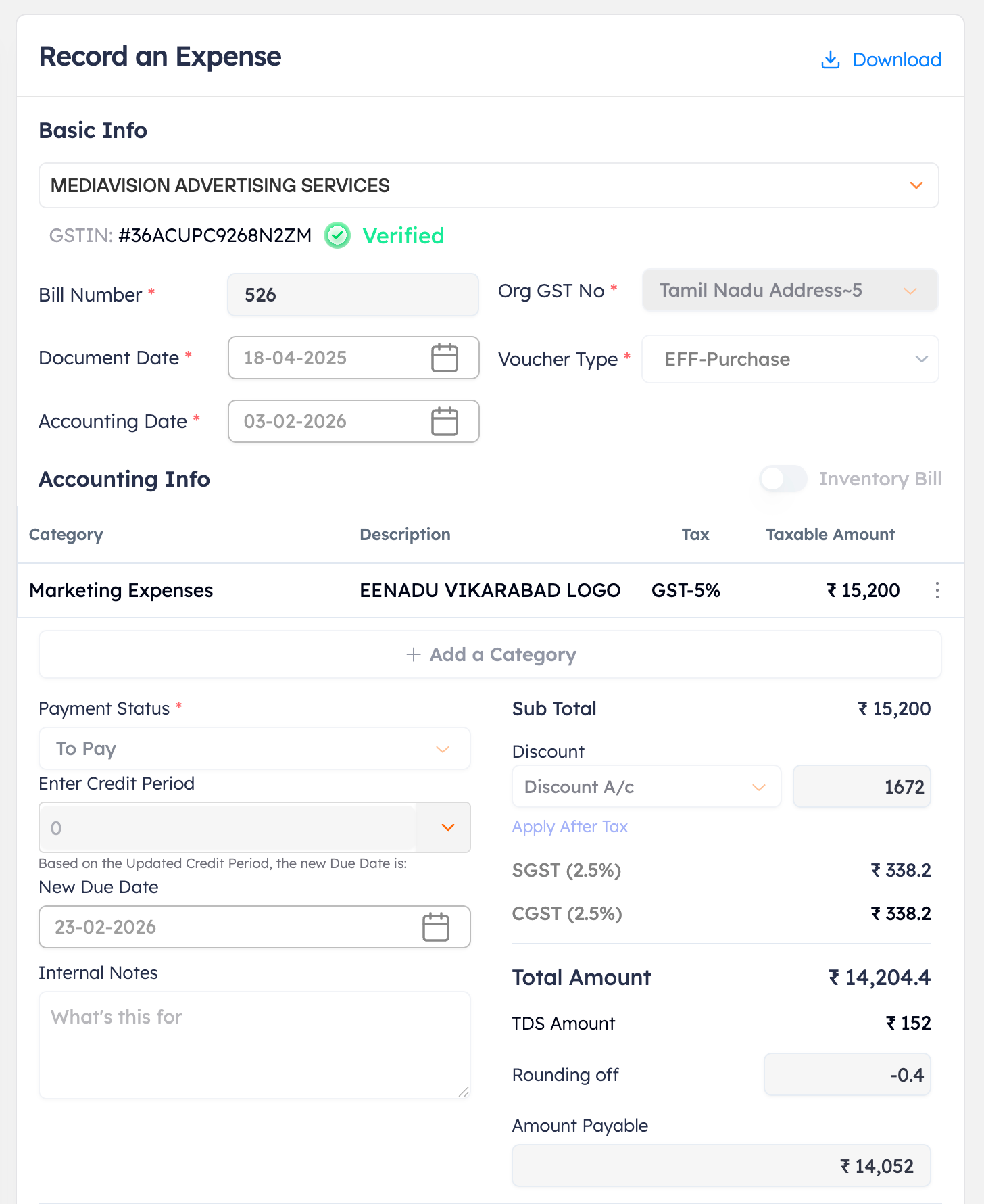
The Risk: If you book a vendor invoice and claim Input Tax Credit (ITC), but that vendor's GSTIN is suspended or they haven't filed their returns, the government will penalize you. You lose the 18% margin. Also, if manually your accountant applies wrong TDS logic (refer all applicable TDS sections here https://www.goeffortless.ai/compliance), then you loose margins in every transaction.
The OCR Failure: OCR will perfectly transcribe the GSTIN string (e.g., 27AAAAA0000A1Z5). But it has no idea if that GSTIN is legally valid. It has no idea about TDS applicability.
The Effortless IDP Solution: We built an App to validate GSTIN. When our IDP extracts the GSTIN from a scanned bill, it doesn't stop there. It instantly pings the government's GSTN portal via API. It checks the live status of the vendor. If the vendor is a defaulter, Effortless flags the invoice immediately: "Warning: Do not pay GST component." It will automatically map the relevant TDS section and TDS amount, along with keeping your TDS files ready for returns.
This is How to avoid GST & TDS penalties through automated billing software.
Pillar 3: Automated Workflow & Policy Enforcement
Data extraction is only half the journey. The data must trigger an action.
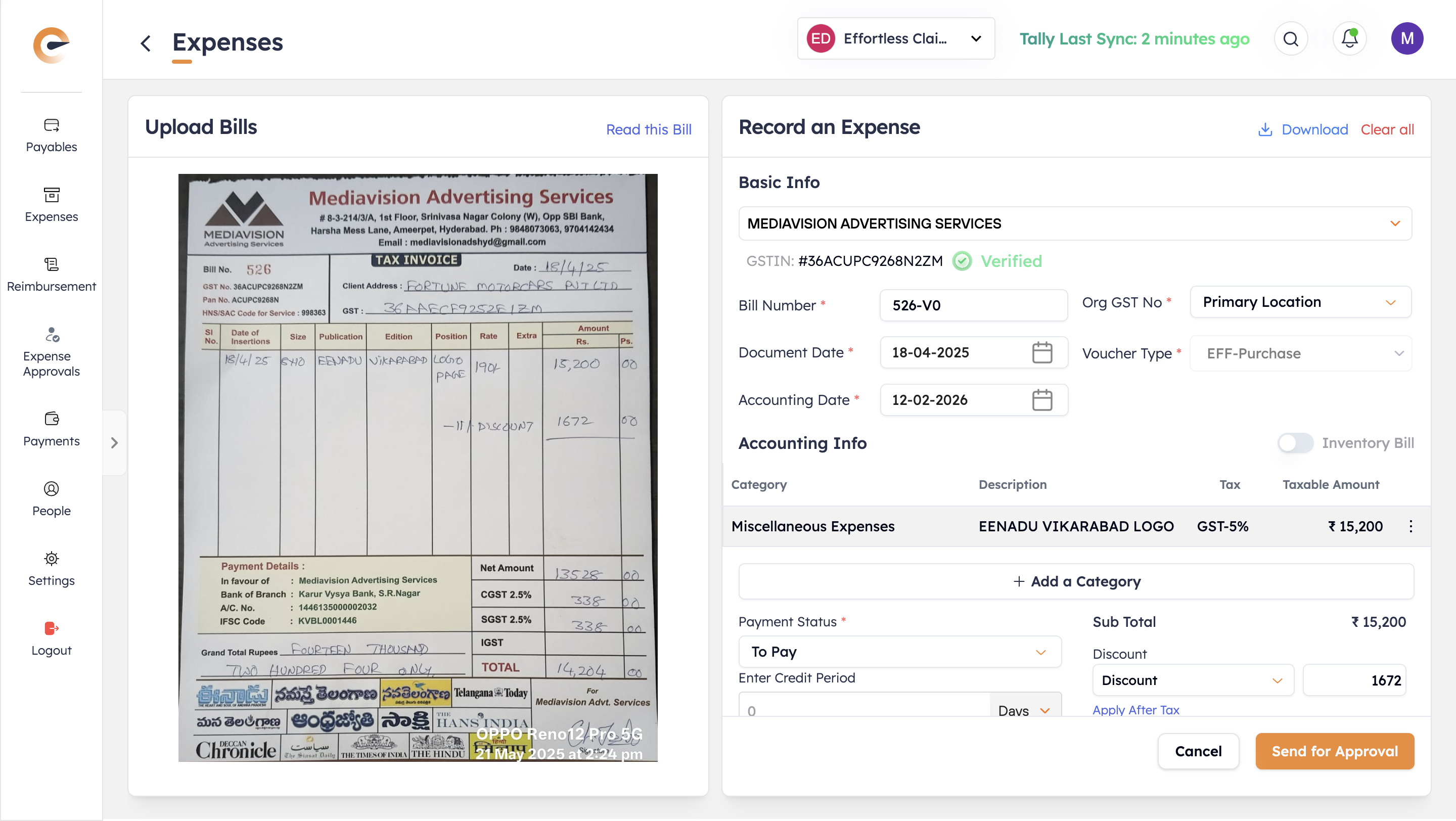
The OCR Failure: Once OCR extracts text, a human still has to review it, check company policy, seek approval, and manually enter it into Tally.
The Effortless IDP Solution: Our IDP feeds directly into our multi-level approval software.
Scenario: A sales rep uploads a hotel bill for ₹4,500.
IDP Action: Extracts amount (₹4,500), Category (Lodging), and Date.
Policy Check: The system checks the rep's grade limit (e.g., Max ₹3,000/night).
Routing: Because it violates policy, IDP automatically routes it to the Area Manager for "Exception Approval."
Tally Sync: Once approved, the data flows seamlessly into Tally as a Journal Voucher.
4. The "Purchase to Pay" Velocity
Let's look at the broader impact on the "Purchase & Expense Management" cycle for a growing enterprise.
The Old Way (Manual/Basic OCR):
Vendors email invoices -> Accountant prints them -> Manually checks against Purchase Order (PO) -> Manually checks GST status -> Types data into Tally-> Manually manages TDS and payable amount. -> Sends a physical file or Email to CFO for payment approval.
Result: High error rate, slow processing (days), and zero real-time visibility.
The Effortless Way (IDP-Driven):
Ingestion: Vendor emails invoice to a dedicated office email-address (or accountant uploads invoice via Effortless Desktop or APP).
IDP Extraction: The system reads the PDF, extracts line items, totals, and taxes.
The "Three-Way Match": The IDP engine automatically compares the Invoice data against the PO data (stored in Tally) and the Goods Received Note (GRN). Auto checks GSTN, TDS applicability.
Anomaly Detection: If the invoice charges ₹50/unit but the PO was for ₹45/unit, the system flags the discrepancy.
Payment Queue: Verified bills sit in a clean dashboard. The CFO approves the payable amount post TDS deduction. The finance team generates a bulk payment file using Effortless generator or directly makes payment using connected banking to process NEFTs directly from the system.
This speed is essential for companies looking for Cash flow management software for MSMEs India. When you process bills faster, you can negotiate early-payment discounts with vendors, turning your Accounts Payable department from a cost center into a profit center.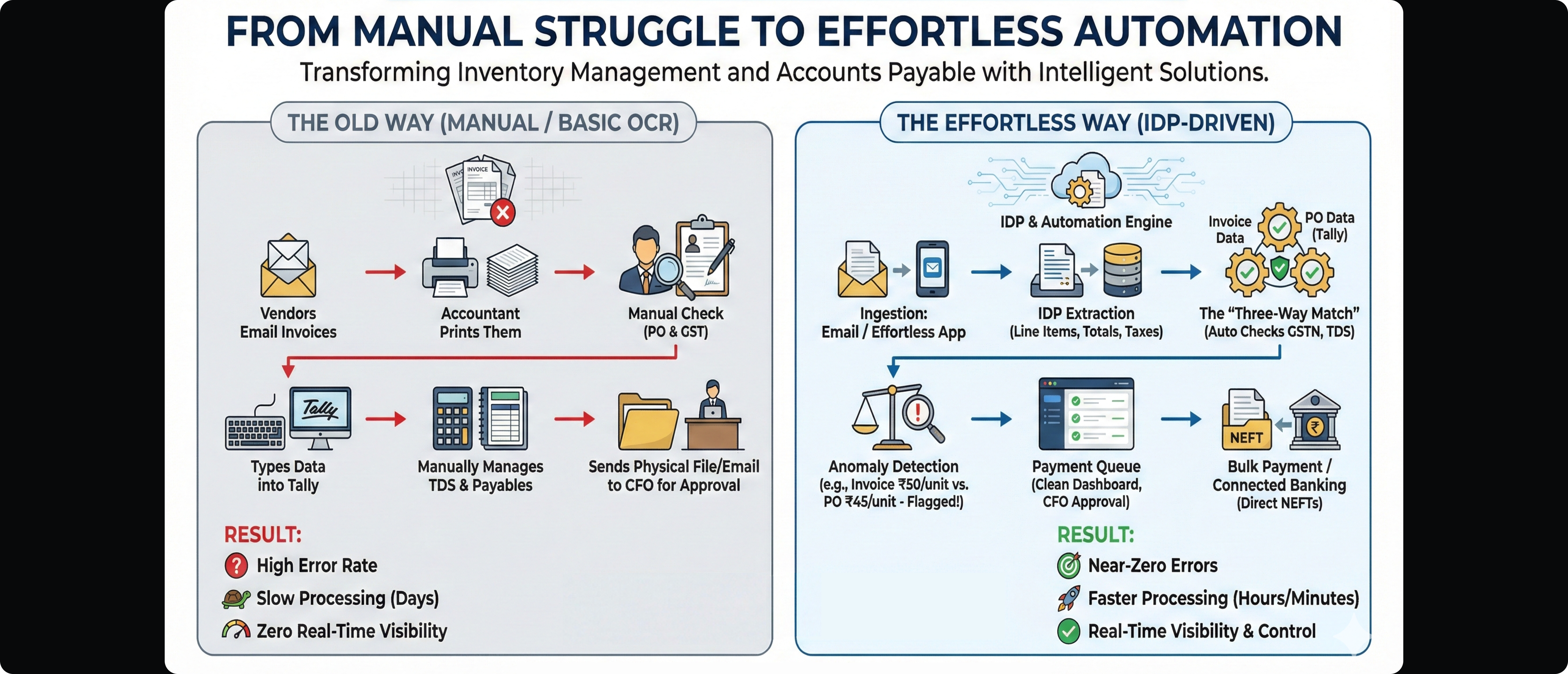
5. Stop Paying for "Software," Start Paying for "Outcomes"
Many generic ERPs and accounting tools boast about having an "OCR Scanner." They treat it as a neat feature.
Warning: Do not be distracted by the scanner.
If a software asks you to define templates for every vendor, or if it requires your accountants to spend 5 minutes verifying every scanned document, you have not bought automation. You have bought a very expensive digital magnifying glass.
True digital transformation requires systems that handle the cognitive load.
When you use the Effortless platform, you are leveraging IDP to get clean, validated, policy-checked, and Tally-ready data. You are freeing your finance team from the drudgery of data entry so they can focus on financial analysis, cash flow forecasting, and strategic growth.
6. Beware of Free or Cheap Alternatives.
Sometimes, Founders and Business Owners come across a vendor offering them some OCR tech at dirt cheap price or free. They often should ask: “Why would someone build something useful and give it away?”
In the consumer world, the answer has been obvious for years.
Google and Facebook aren’t free because they’re generous. They’re free because they’re harvesting something more valuable than money: your attention, behaviour, and everything attached to your identity. That is “You.”
Every search query, every like, every swipe—each one fine-tunes an algorithm that sells you better.
This model of “if you’re not paying for the product, you are the product” is well understood in B2C. But what’s less obvious is how this mindset has seeped into business software.
Have you ever signed up for free Invoicing or expense-related software, and are suddenly bombarded with calls for free loans the very next day? Or agents calling you regarding some hidden costs missed in the fine print following your purchase and following one-month of usage?
Sounds familiar?
What starts as a helpful utility eventually becomes a wedge—into your data, your behavior, your funnel.
The pitch is always the same: “Try it now. Pay later.”
But in the background, your usage patterns, customer journeys, and business workflows are quietly being mapped. Your operational behaviour becomes market intelligence. Sometimes to upsell you. Sometimes to cross-sell your competitors. Sometimes—simply to train AI models that will power something else entirely.
The point is: someone is extracting value.
And if you’re not the one paying, you’re almost certainly the one being harvested.
So when you’re installing that “almost free” Tally/ERP Integration Tool, what you’re really installing is a sensor—one that listens to your finance, sales, and ops engines, feeding insights elsewhere.
Do read this article written by our founder: (Hidden Cost of Free).
Key Takeaways & FAQ
Q1: Will IDP eliminate the need for my data entry operators?
A: Yes, for routine typing tasks. IDP handles the heavy lifting of extraction and basic validation. Your data entry staff can be upskilled to handle "Exception Management" (reviewing the 1-2% of documents the AI flags) or shifted to higher-value roles like collections or vendor relations.
Q2: How does Effortless handle handwritten employee expense claims?
A: Our employee expense claim app uses advanced IDP models trained specifically on complex handwriting and sub-standard image quality (like crumpled thermal receipts). It recognizes the context—distinguishing the written amount from the date—with far higher accuracy than traditional OCR.
Q3: Can IDP help with my month-end Tally reconciliation?
A: Absolutely. Because IDP ensures the data entering the system is accurate and automatically synced to Tally, the "garbage in" problem is eliminated. When combined with our features that show how to automate bank reconciliation with Tally, your month-end close can be reduced from days to hours.
Q4: Do I have to create templates for new vendors?
A: No. Effortless IDP is template-free. It uses AI to understand the structure of an invoice, regardless of whether the vendor puts the "Total" at the top right or the bottom left. It adapts automatically.
Q5: Is this a replacement for Tally?
A: No. Effortless is a Tally-integrated solution platform. We act as the intelligent "front door" for your data. IDP processes and validates the messy documents, and then pushes the clean, structured financial entries into Tally, which remains your secure System of Record.
Suggested Reading from the Effortless Edge Blog:
The Invoice Anatomy: Detecting fake GST bills before they hit your books – How IDP protects your Input Tax Credit.
Why "Generic" Cloud ERPs Fail in Indian Distribution Businesses – Why deep local context beats generic software.
Don’t Fire Your Munim-ji: Balancing modern tech with traditional accounting wisdom – How IDP empowers your senior accountants.
Stop the Leakage: 5 Ways Manual Expense Claims Cost You 4% of Revenue– The financial cost of ignoring automation.
Is your finance team still typing out invoices?
[Book an IDP Demo] and see Effortless process your messiest vendor bill in seconds.
Watch (English):
Watch (Hindi):
Growth Doesn't Wait. Why Should You?
Let Effortless help you scale—without the scramble.
Talk to Us
Have questions about how Effortless can transform your business? Our team of experts is ready to help.
- Schedule a personalized demo
- Get your specific questions answered
- Discuss your unique business challenges
We'll reach out within 4 business hours
Request Demo
See Effortless in action with a personalized demo tailored to your business.
- No generic presentations
- Focus on your specific challenges
- Get a clear picture of your potential ROI
Choose a time that works for you
Your Growth Engine Starts Here
More growth, less overhead. Discover how India's fastest growing businesses do it.
- Automate invoicing, collections & approvals
- Track sales team performance
- Get cashflow clarity in real-time
Clarity in 30 minutes. No pressure, just proof.